
Ramsey Nasser
nasser@merveilles.town
me: distributed trust is tricky! I wonder how other distributed systems solve it
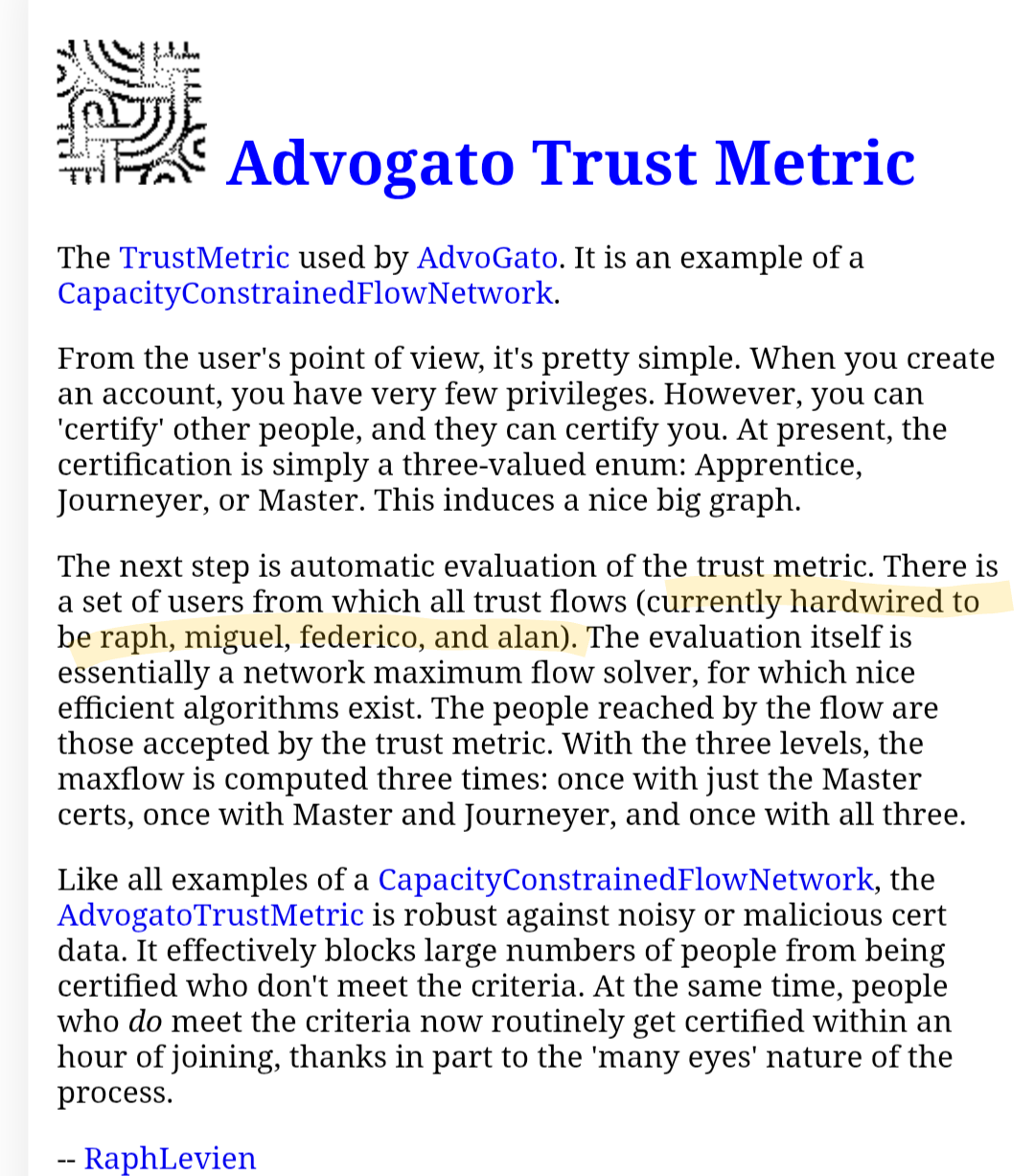
other distributed system: have you tried hard coding four men as the arbiters of trust
 2
2
 0
0
 1
1
Ramsey Nasser
nasser@merveilles.town
the hardest part of building a decentralized network is where to hide the centralization
4
4
1

endrift 🏳️⚧️
endrift@treehouse.systems@nasser @0xabad1dea whenever someone calls bsky decentralized I roll my eyes
1
0
1

Charlotte  /Cinny



charlotte
@endrift @nasser @0xabad1dea before i turned off the bridgy bridge for my account every single time i complained about “bluesky is centralized” issues folks that are working on ATmosphere projects are suddenly very interested in proving me wrong
0
0
1

@nasser I knew this was about DNS before I even looked at the thread.
even Fedi's downfall is the centralisation is the US dominance (and recent interference) of DNS
1
0
0


James Henstridge
jamesh@aus.social@aral @dee @nasser this reminds me a bit of a a .com era company that was trying to sell a service to map numbers to domain names, with the shorter numbers costing more.
It's not clear going back to IP addresses really helps here: they're also centrally allocated, and long term exclusive use of an IPv4 address is probably going to be more expensive than a domain name (that could be updated with new dynamic IP assignments).
1
0
0

Lambda Crime [The Möth Society]
16af93@wetdry.worldIt's not clear going back to IP addresses really helps here: they're also centrally allocated, and long term exclusive use of an IPv4 address is probably going to be more expensive than a domain name (that could be updated with new dynamic IP assignments).
- IPs are terrible as unique identifiers for people (cuz they weren't real made with that use-case in mind) as they only identify a single machine (in the best case)
- most people sit behind an IPv4 NAT (maybe even two or more NATs) which means they don't have a global address
- getting a fixed IP generally is expensive with either you needing to run a whole AS to be provider independent or pay a lot for a fixed one to an ISP (IPs generally aren't moveable between providers so good luck keeping your IP if you want to switch to a different ISP, phone numbers can at least in europa be moved between providers)
- IPv4 might be human-usable, but IPv6 isn't really (people already have a hard time correctly writing down up to 16 digits, now make that an IPv6 address with letters and numbers
especially point 3 kills IPs as something that is in anyway usable beyond a small elite with the tech know-how, cuz at least with domains you can tell people without big tech kowledge who want to host stuff: go to $RegistraYouTrust, pick a domain you like that is still free, and throw a few files of html on $WebHostingProvider or pay $ManagedWordpressHoster
further an AS can in theory also be blocked/the assigned IPs taken by force if the right people want to
did you think about those people? the people who will only be confused by being told "IPs are basically just phone numbers!"?
cuz if you didn't, then you ain't building a small web to connect people, but rather a bubble of isolationists
the internet became what it is thx TO all the people with barely any tech know-how (this includes even scientists and other specialists)
so the real question is: why are you so focused on bringing back a pre-eternal september world?
0
0
0

joepie91 needs more railing (🔜 eth0)
joepie91@slightly.tech@nasser I remember playing "spot the central server" with every new 'whitepaper' coming out of some cryptoshit project.
the people hawking these things didn't really appreciate the game.
0
0
0

estelle
estelle@mstdn.social@nasser this post made me think, "wait, what happens when someone actually succeeds" and then remember freenet, so i look it up and it's called hyphanet now, and the problems are extremely predictable,
*looks at fedi at large*
i'm not sure there's a perfect answer to this one but clearly the bluesky approach ain't it either
1
0
0

[4FBB09]
5225225@furry.engineer@estelle @nasser curious: what's the issues with hyphanet? i'm not that familiar with its internals (tried it out ages ago, long before the rename, haven't touched it since), but skimming the docs seems somewhat reasonable
(maybe with issues about deanonymization if you pick attackers as direct peers(insecure mode)?, and social graph leakage if you pick friends?)
1
0
0
[4FBB09]
5225225@furry.engineer@estelle @nasser i don't think "being able to host questionable content" is a flaw. that's kinda inherent to the design of (real) anonymity software. the alternative is "governments can pressure people into not hosting your stuff" which is Suboptimal.
(carriers being held responsible for what they carried for(but didn't request) would be more of an issue imo. arguably hyphanet has that as an issue because of the storage, where you are storing (encrypted pieces) of content on the network. that goes and ties into the first point though)
1
0
0
estelle
estelle@mstdn.social@5225225 @nasser i'm not entirely sure where the line should be drawn either, nor familiar enough with hyphanet protocol to say if there's any way to mitigate things such as, for example, revenge porn, but it seems a truly decentralized system necessarily comes with some compromises that would need to be resolved at some other level in society,
1
0
0
estelle
estelle@mstdn.social@5225225 @nasser (...i'm actually not that great at computer but it occurs to me that in order to access data you'd still need to query for it and perhaps community consensus can decide certain hashes of the data maybe should not be forwarded if they're seen. that could itself lead to divulging information about who routes things though. but again, i'm not good at this)
1
0
0
[4FBB09]
5225225@furry.engineer@estelle @nasser maybe. though if that were possible, if you build a system for censorship, the community members (who exist under governments) can be pressured into using that tool in order to censor stuff the government doesn't like
not that it's completely not an issue here, but an all or nothing of "you need to make using this tool at all criminal or not"
(and generally the answer is "not criminal" the same way hosting a VPN company isn't illegal, because they do not censor. at least in US law, once you start filtering traffic, you become more responsible it, at least for DMCA safe harbor purposes, similar laws probably apply elsewhere)
being able to say "i have no technological means to censor/know what people are requesting through me" is a nice property to have.
so for that reason i think it's a binary thing of "can you, as a "router", censor stuff?", and "no." is the better answer.
not that revenge porn is good, obviously, but 2 mutually consenting peers should be able to communicate
0
0
0